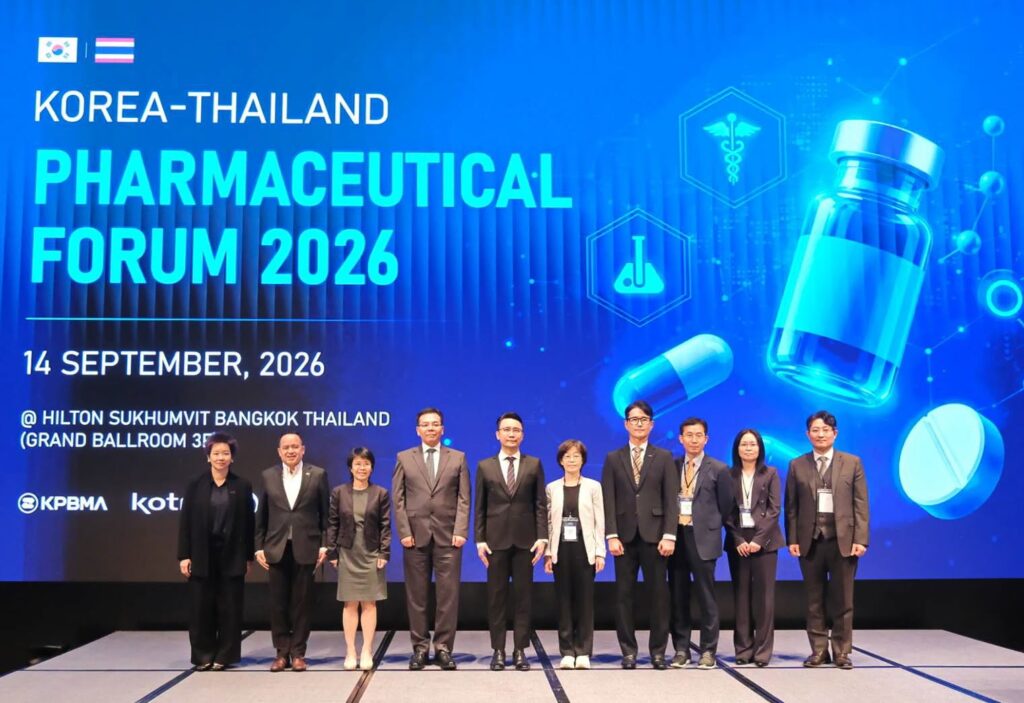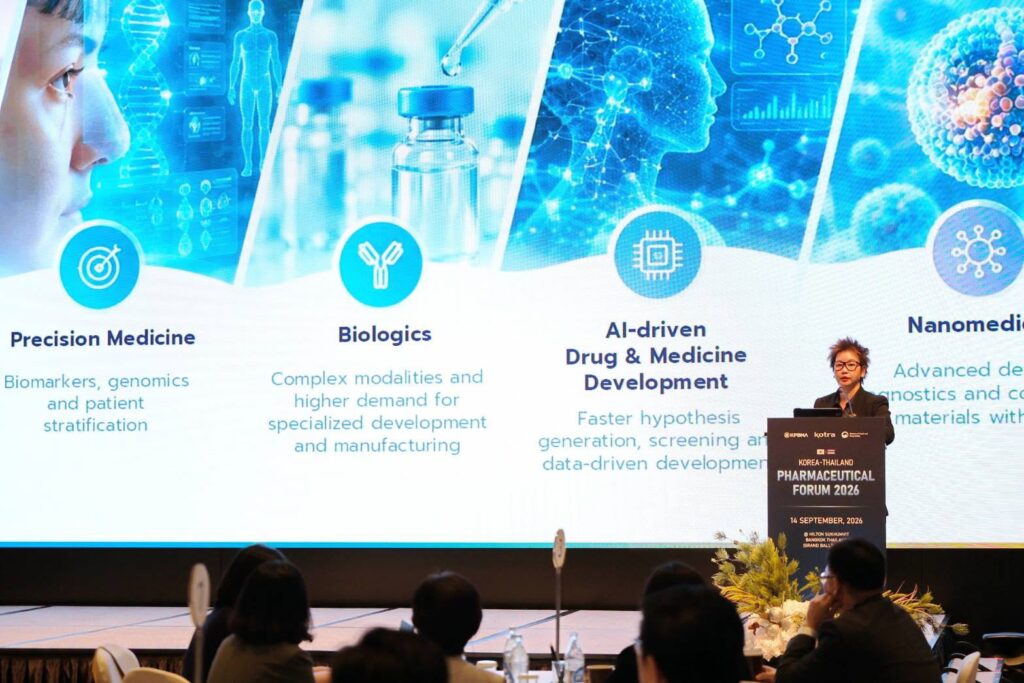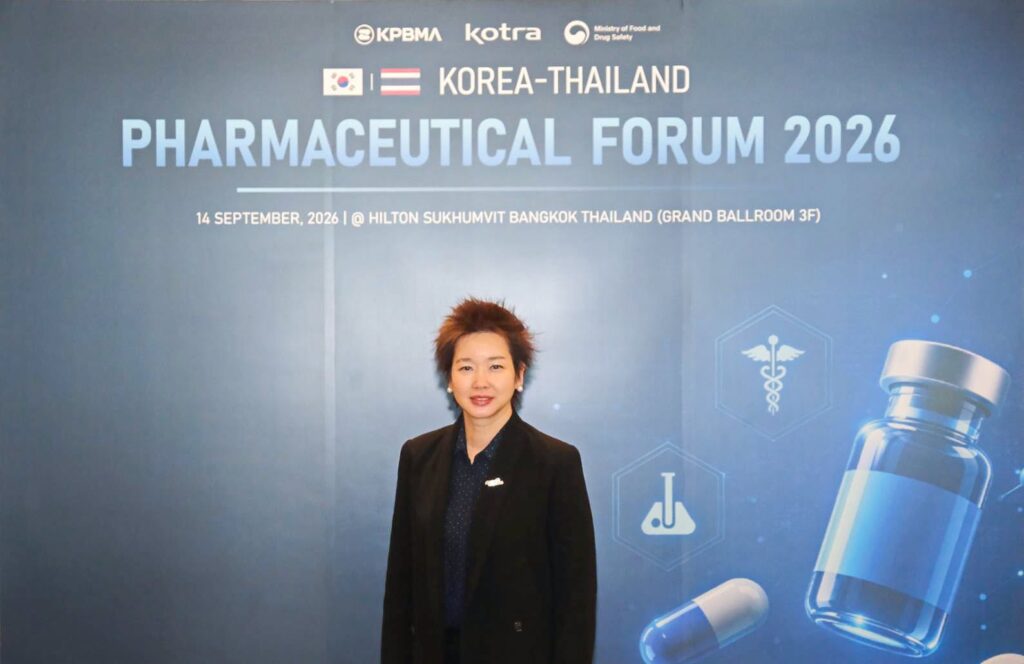

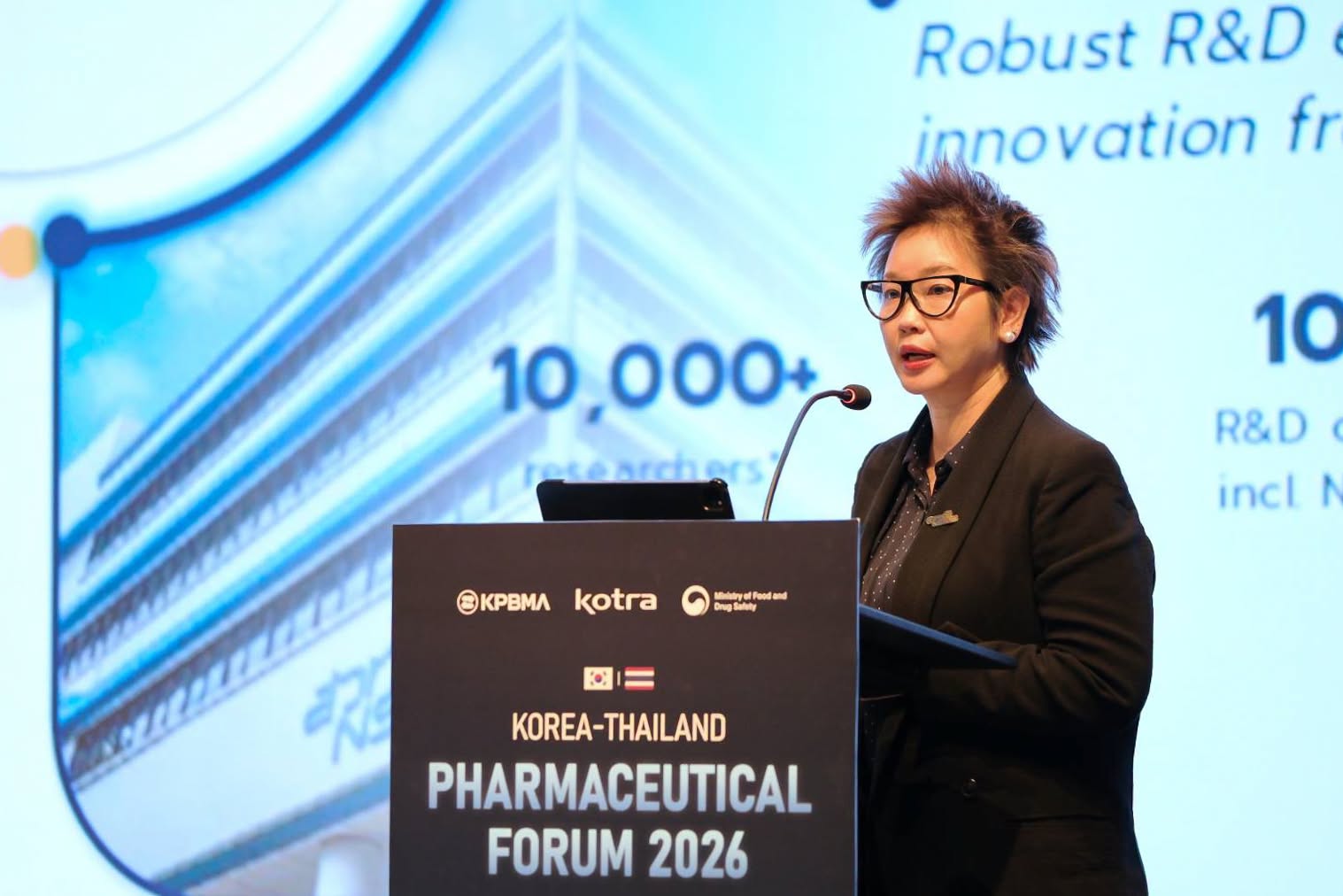
Dr. Uracha Rukhtanontchai, Director of the National Nanotechnology Center (NANOTEC), National Science and Technology Development Agency (NSTDA), delivered a presentation titled “R&D Trends in Thailand’s Pharma & Bio Sector” at the Korea-Thailand Pharmaceutical Forum, organized by the Korea Trade-Investment Promotion Agency (KOTRA) Bangkok in collaboration with the Korea Pharmaceutical and Bio-Pharma Manufacturers Association (KPBMA) on September 14, 2026. Her presentation highlighted Thailand’s research and development directions in the pharmaceutical and biotechnology sectors, as well as the potential of the country’s research ecosystem to respond to transformations in the global healthcare industry. These changes are being driven by an aging society, precision medicine, biologics, artificial intelligence (AI)-enabled drug discovery and development, and nanomedicine, leading to increasingly patient-specific approaches to drug development and treatment, alongside greater use of biological data and advanced technologies.
Dr. Uracha noted that Thailand possesses significant potential to upgrade its pharmaceutical and biotechnology industries toward high-value products. Key strengths include the country’s rich biodiversity and agricultural resources, which can be further developed into active ingredients and health products; a well-established healthcare system and medical infrastructure; and a research and development ecosystem comprising research organizations, universities, hospitals, industry, and government support mechanisms. These elements collectively connect knowledge creation and technology development with testing, technology transfer, and real-world applications. NSTDA serves as one of the key mechanisms linking the research sector with industry and national development goals.
Thailand’s R&D landscape is currently moving in six key directions: 1) Advanced Therapies & Biologics, covering the development of biologics, vaccines, biosimilars, and advanced therapies such as advanced therapy medicinal products (ATMPs) to strengthen domestic healthcare and manufacturing capabilities; 2) Precision Medicine & Omics, applying genomic data, biomarkers, and omics technologies to support prevention, diagnosis, and treatment tailored to individual patients; 3) AI & Digital Health, applying AI to drug discovery and development, healthcare, and the utilization of health data; 4) RNA & Advanced Delivery, advancing mRNA technologies and advanced delivery systems, including lipid nanoparticles (LNPs), microneedles, and nanocarriers, to improve the efficiency and specificity of active-ingredient delivery; 5) Natural Products for Health & Wellness, leveraging Thailand’s biological resources through the discovery and development of active ingredients, standardization, and nanoencapsulation; and 6) Biomanufacturing & Translation, focusing on scale-up manufacturing, GMP- and CMC-compliant processes, and technology transfer to move research from the laboratory toward manufacturing and real-world applications. These directions are aligned with the technology groups and infrastructure prioritized by NSTDA.
To support these emerging directions, NANOTEC, NSTDA, has developed technology platforms, particularly in drug delivery and nanomedicine. These include Lipid Nanoparticle (LNP) technologies for the delivery of mRNA, vaccines, and nucleic acids; technologies for enhancing bioavailability and controlling the release of active ingredients; and micro- and nanoneedle technologies for transdermal delivery and minimally invasive diagnostics. NANOTEC is also developing biosensors and rapid diagnostic platforms, as well as extraction and purification technologies for obtaining standardized natural active ingredients and nanoencapsulation technologies for the development of health, beauty, and wellness products.
Examples of research translation and technology utilization include N-JOINT, a microneedle platform for transdermal drug delivery that has been transferred to a startup company and applied clinically within the Phyathai–Paolo Hospital network, with its applications subsequently expanded to the BDMS network. Another example is DoPoom, a microneedle patch for allergy testing designed to reduce pain and improve diagnostic accuracy. NANOTEC has also initiated the SME Q UP (Quality Upgrade Platform for Health SMEs) project to support entrepreneurs throughout the product development process—from product readiness assessment, formulation development, and the application of nanotechnology to stability, quality, safety, and efficacy evaluation, through to the preparation of information to facilitate market access.
Dr. Uracha emphasized that upgrading the pharmaceutical and biotechnology industries requires the integration of research, technology, manufacturing, and markets. NANOTEC, NSTDA, aims to serve as a strategic partner that connects research excellence with industrial applications and international collaboration. In terms of Thailand–Korea cooperation, opportunities for joint development include LNPs, targeted drug-delivery systems, AI-assisted nanopharmaceutical formulation, clinical testing, biopharmaceutical manufacturing scale-up, and pilot-scale production in accordance with GMP standards, as well as researcher exchanges and joint research funding mechanisms. Such collaboration could accelerate the transition from research to practical applications while strengthening pharmaceutical and healthcare innovation capabilities in both countries.