
NANOTEC NSTDA Unveils 3 Innovations from 3 Industry Partners to Drive Thai Herbal Products into High-Value Markets
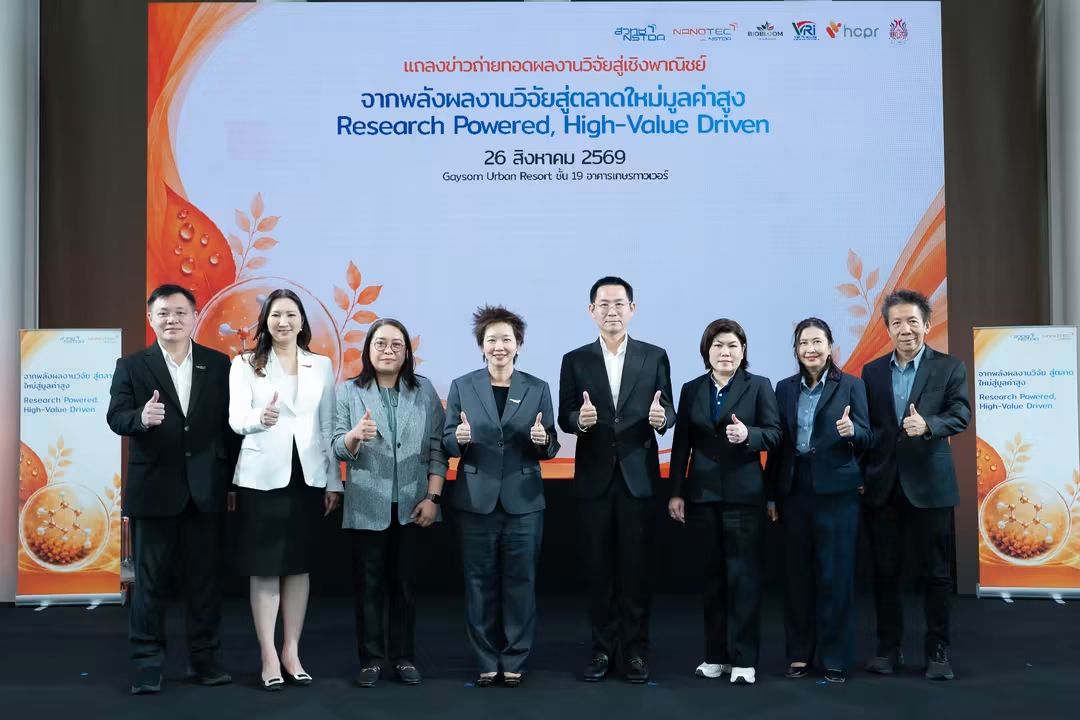
Under the Ministry of Higher Education, Science, Research and Innovation (MHESI), the National Nanotechnology Center (NANOTEC), National Science and Technology Development Agency (NSTDA), is advancing research on herbal extracts toward commercial applications with the launch of three innovative products: effervescent tablets containing encapsulated curcuminoid particles; a sunspot-reducing product formulated with porcine placenta extract; and an antifungal product for pets formulated with extracts of Streblus asper and saponins. Developed in collaboration with three private-sector partners that have completed market opportunity assessments and decided to pursue technology transfer, the three innovations were developed under the project “Creating Value for Herbal Products toward New High-Value Markets.” NANOTEC also hosted the event “From Research Innovations to New High-Value Markets,” aimed at connecting knowledge, technology, and the business sector to increase the value of Thai herbs and create innovative products that respond to high-value market demands.
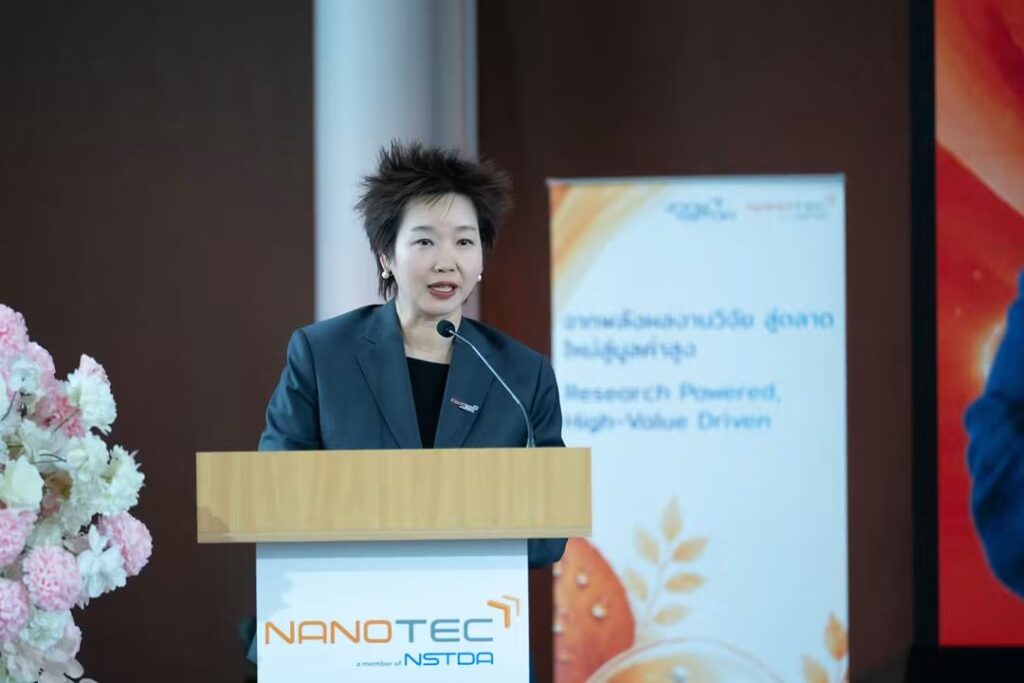
Dr. Uracha Ruktanonchai, Director of the National Nanotechnology Center (NANOTEC), NSTDA, said that NANOTEC has adopted a policy of applying science, technology, and innovation to develop Thai herbs into high-quality, distinctive, and competitive products for high-value markets. The project serves as an important mechanism for bridging research and business needs by developing product prototypes to a stage where entrepreneurs can test them with target customers, assess production costs, business plans, and market opportunities before deciding to pursue technology transfer.
“We have designed this project to serve as a shortcut to innovation by helping bridge the gap between research outcomes and actual industrial-scale production. This includes assessing production feasibility, investment requirements, costs, selling prices, product standards, and consumer acceptance. Once entrepreneurs recognize the opportunities and gain confidence in the research outcomes, they can proceed with technology transfer. This increases the likelihood that research will reach actual users, while providing entrepreneurs with information to support their decisions and reduce investment risks,” Dr. Uracha said.
Under the “Creating Value for Herbal Products toward New High-Value Markets” project, a total of seven product prototypes were developed. Three private-sector companies subsequently completed market testing and decided to pursue technology transfer. They are HC & PR Pharmaceutical Co., Ltd., with technology for producing curcuminoid particles for use in effervescent tablets; Bio Bloom Co., Ltd., under Saraburi Farm Group, with a product developed from porcine placenta protein extract for reducing sunspots; and Vet Products Research and Innovation Center Co., Ltd. (VRI), with a product developed from Streblus asper and saponin extracts for combating fungal infections of pets’ skin.
The “Creating Value for Herbal Products toward New High-Value Markets” project represents a research support model designed to provide the private sector with access to high-potential research while enabling market demand and business feasibility to be tested before entering the technology transfer process. The successful technology transfer of the three pilot innovations demonstrates the potential of a mechanism that allows research outcomes to be tested in the market before being transferred to the private sector. This approach helps build entrepreneurs’ confidence, reduce investment risks associated with adopting new technologies, and increase the likelihood that research will be put into practical use. At the same time, consumers will have greater access to high-quality herbal products supported by scientific evidence, while researchers and NSTDA can further develop knowledge and technologies to generate economic and social impact—contributing concretely to the advancement of “Thai herbs from research to high-value products and global markets.”